
What is a Webkeeper?

You build websites. That’s what you tell people at parties, and it’s true. But it’s not the whole picture. Because after the launch — after the confetti and the “it looks amazing” emails — your phone keeps ringing. And it’s not about the next build. It’s about the last one. “The form stopped working.” “Can you change the hours on the homepage?” “Our payment processor sent us an email and we don’t know what it means.” “There’s an update and now everything looks different.” “We just need someone to handle this.” So you handle it. You fix the form. You update the hours. You call the payment processor and figure out what changed. You run the update and test everything afterward. You do it because the client trusts you, and because nobody else is going to. Related article: What are Webkeeping Services? You may not have a word for this work. But there is one. You’re a webkeeper. The Work That Doesn’t Have a Name Every web professional knows there are two kinds of work. There’s the project — the big build, the redesign, the new site. And then there’s everything after. The “after” work is where most of the trust gets built. It’s the ongoing relationship. The retainer. The monthly check-in. The “hey, can you take a look at this?” calls. It’s not glamorous. Nobody gives conference talks about updating a dentist’s holiday hours or reconnecting a church’ event registration form. But it’s steady, it’s needed, and for a lot of small web shops, it’s what keeps the lights on. The problem is, this work has never had a professional identity. “Website maintenance” undersells it. “Managed services” sounds like enterprise IT. “Support” sounds like a help desk. None of those words capture what it actually means to be the person a small business calls when anything on their web isn’t working. Webkeeping is that word. And a webkeeper is the person who does it. What a Webkeeper Actually Does Think of it like bookkeeping. A bookkeeper doesn’t just balance one account — they manage all of your books, ongoing, so you don’t have to think about it. A webkeeper does the same thing for everything a business does on the web. That includes the obvious stuff: website updates, content changes, design tweaks. But it also includes the operational layer that most businesses now depend on — payment portals, scheduling systems, online forms, member directories, event registration, document repositories. The tools that customers, patients, members, and constituents actually use to interact with an organization. A webkeeper manages all of it. Not just the website. Everything web-based that the business needs to keep running. And when things change — when a vendor gets acquired, when a platform sunsets a feature, when an integration breaks after an update nobody asked for — a webkeeper is the one who picks up the phone, says yes, and figures it out. You Might Already Be One If you’re reading this, there’s a decent chance you already do this work. You just call it something else. Maybe you call it “maintenance clients.” Maybe you call it “ongoing support.” Maybe you don’t call it anything — it’s just the part of your business that happens between the projects. Here’s the question worth asking: is that the work you want to be doing? Some web professionals love the build and tolerate the maintenance. The ongoing support is a revenue stream, but it’s not the thing that gets them out of bed. If that’s you, there’s no shame in it. But those clients still need someone. And handing them off to a dedicated webkeeper means they’re taken care of — and you get to focus on what you actually want to do. Other web professionals discover that the ongoing work is actually what they’re best at. The relationships. The trust. The satisfaction of being the person someone calls when they need help. If that’s you, then congratulations — you’re a webkeeper, and there’s a growing community of people who do exactly what you do. Either way, the word exists now. And it changes how you think about the work. Why This Matters Right Now The web is getting more complicated. Every tool a business uses is adding AI features, changing its pricing, updating its interface. New platforms launch every week. And the people who set up these systems for small businesses — the freelancers, the small agencies, the solo operators — a lot of them are stepping back. The industry is shifting, and some shops are closing. But the dentist’s scheduling system still needs to work. The town’s water bill portal still needs to accept payments. The church’s event registration still needs to function for the fall retreat. Those organizations don’t stop needing help just because the person who built their site moved on. That’s why webkeeping matters. Not as a buzzword, but as a professional category. The work is real. The need is growing. And the people who do it well deserve a name for what they do. Parker Web Has Been Webkeeping Since 1999 We didn’t coin the term to sell a product. We coined it because after years of doing this work, we realized there wasn’t a word for it — and there needed to be. Parker Web handles about 5,000 support requests a year for small businesses and community organizations in 31 states. We’ve maintained a 99% client satisfaction rating. We work in WordPress, Joomla, Shopify, HubSpot, Squarespace, and most other platforms. If it’s on the web and a business depends on it, we handle it. We’re not the only webkeepers out there. But we might be the first ones to say it out loud. Let’s Talk Whether you’re a webkeeper yourself and want to connect with others doing this work, or you’re a web professional looking to hand off maintenance clients to someone who’ll treat them right — we’d like to hear from you. Call us at 877-321-2251 or visit parkerweb.com/partners. Related: See
What are Webkeeping services?
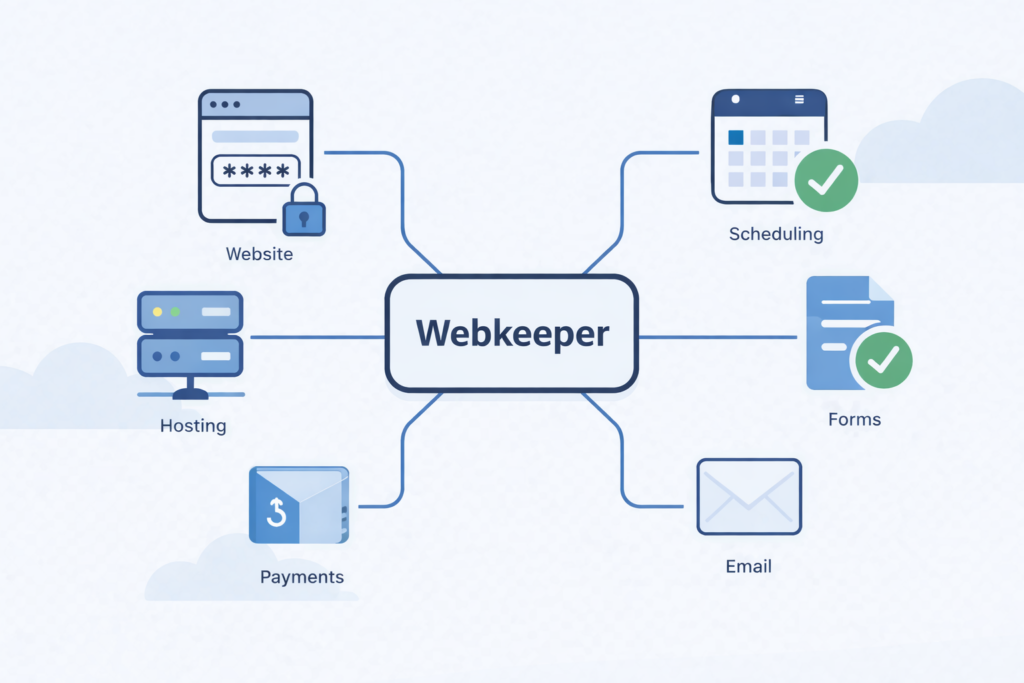
If you run a small business, a church, a municipality, or a community organization, you depend on things that live on the web. Your website is one of them. But it’s probably not the only one. There’s also the payment portal where your customers pay their bills. The scheduling system where your patients book appointments. The forms your constituents fill out for permits or registrations. The grade portal parents check every week. The public agendas your board posts before every meeting. The event registration your members use to sign up for the mission trip. All of that is web-based. All of it needs to keep working. And most of it was set up by someone, at some point, and nobody inside your organization fully understands how it all connects anymore. Related article: What is a webkeeper? That’s what webkeeping is. It’s the ongoing management, maintenance, and care of everything your organization does on the web. It’s Bigger Than Your Website We’ve been providing website maintenance services since 1999. For a long time, that described the work pretty well. A client would call and say “can you change the phone number on the contact page” or “we need to add the new holiday hours,” and we’d handle it. Usually within a few hours. We still do that, every day. But over the years, the work grew. Clients started asking us to set up their payment portals. Connect their scheduling tools. Build their online forms. Manage integrations between systems that were never designed to talk to each other. And when any of it broke — when the scheduling vendor pushed an update that changed everything, when the payment processor changed its requirements, when a form stopped working after a plugin update — they called us. They didn’t call because they wanted to learn how to fix it themselves. They called because they had patients to see, meetings to run, customers to serve. They needed someone to just handle it. “Website maintenance” doesn’t really cover that anymore. Webkeeping does. What Does a Webkeeper Actually Do? Think of it like a bookkeeper. A bookkeeper doesn’t just balance one account. They manage your books — all of them, ongoing, so you don’t have to think about it. A webkeeper does the same thing for everything your business does on the web. Here’s what that looks like in practice: Website updates and changes. Text, images, pages, new content, design tweaks. The core of what we’ve always done, and what we’ll keep doing. Operational systems. Payment portals, scheduling tools, online forms, document repositories, event registration, member directories. The stuff your customers, patients, constituents, and members actually use to interact with your organization. Third-party tool management. Your web presence probably relies on a half-dozen tools from different vendors — your hosting, your CMS, your email platform, your form builder, your payment processor, your scheduling widget. Each one has its own updates, its own pricing changes, its own occasional breakdowns. A webkeeper keeps track of all of it so you don’t have to. Triage when things change. And things are changing faster than ever. Your scheduling vendor gets acquired and announces a new interface. Your form builder sunsets the version you’ve been using. Your CMS pushes an update that breaks an integration you didn’t even know existed. A webkeeper gets the call, says yes, and figures it out. Why Now? The honest answer: the web is getting more complicated, not less.Every tool your business uses is adding AI features, changing its interface, adjusting its pricing. New tools are launching every week that claim to solve problems you’re not sure you have. Your inbox has pitches from vendors you’ve never heard of. And your web person — the freelancer who set up your site five years ago — may not be around much longer. A lot of small web shops and independent operators are closing as the industry shifts. When that happens, their clients don’t stop needing help. The dentist’s scheduling system still needs to work. The town’s payment portal still needs to accept water bill payments. The church’s event registration still needs to function for the fall retreat. Those clients need a webkeeper. Someone who picks up the phone, says yes, and handles it — the way it’s always been done around here. How Is Webkeeping Different From Website Maintenance? It’s not different. It’s bigger. Website maintenance is part of webkeeping — the part focused specifically on your website. Webkeeping covers the website plus everything else web-based that your organization depends on. If it runs in a browser and your business needs it to work, it falls under webkeeping. Think of it this way: a plumber doesn’t just fix toilets. A plumber handles everything connected to your water systems — sinks, water heaters, pipes, drains, supply lines. You call a plumber and whatever the water problem is, they handle it. A webkeeper is the same idea for everything your business does on the web. Whatever the web problem is, we handle it. Parker Web Has Been Doing This Since 1999 We just didn’t have the word for it until now. For 27 years, we’ve been the people small businesses and community organizations call when something on their web isn’t working, or when they need something changed, or when a vendor makes their life complicated. We answer the phone. We say yes. We fix it. We resolve about 5,000 support requests a year, and in 2023, our clients gave us a 99% “very satisfied” rating. We’re a U.S. company with U.S.-based employees, serving clients in 31 states. We work in WordPress, Joomla, Shopify, HubSpot, Squarespace, and most other web platforms. If it’s on the web and your business depends on it, we can help. That’s webkeeping. And we’d love to be your webkeeper. Have questions about webkeeping services or want to find out if Parker Web is a good fit for your organization? Give us a call at 877-321-2251 or get started here. It doesn’t cost anything for an
Freshen Up Your Online Presence: Tips for Website Spring Cleaning 🌱

Discover expert tips and strategies for revitalizing your online presence with our comprehensive guide to website spring cleaning. Learn how to optimize content, streamline navigation, enhance visual appeal, and more for a polished and engaging website experience.
Ensuring Longevity: Strategies for Maximizing Your Website’s Lifespan

In the ever-evolving digital landscape, the lifespan of a website can vary greatly. Factors like technological advancements, changing consumer preferences, and algorithm updates constantly shape the online environment. However, there are strategies you can employ to prolong your website’s existence and maintain a strong online presence. Here are some tips to help maximize your website’s lifespan: By implementing these strategies and staying proactive in managing your website, you can maximize its lifespan and ensure a strong online presence for years to come. Remember, the digital landscape is constantly evolving, so staying informed and agile is key to staying ahead of the competition.