
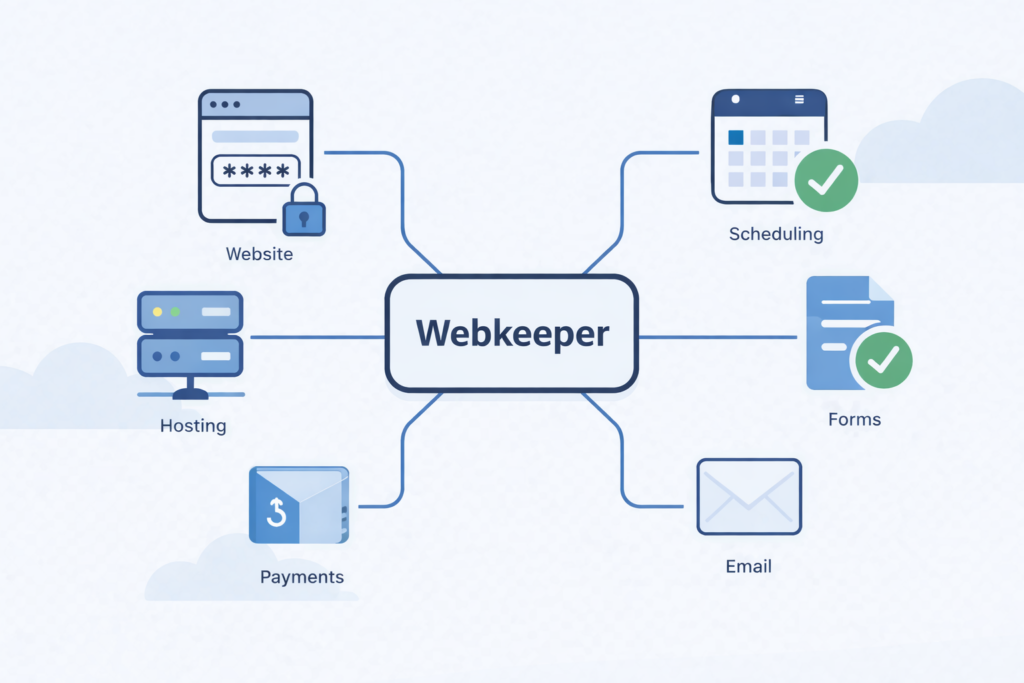
If you run a small business, a church, a municipality, or a community organization, you depend on things that live on the web. Your website is one of them. But it’s probably not the only one.
There’s also the payment portal where your customers pay their bills. The scheduling system where your patients book appointments. The forms your constituents fill out for permits or registrations. The grade portal parents check every week. The public agendas your board posts before every meeting. The event registration your members use to sign up for the mission trip.
All of that is web-based. All of it needs to keep working. And most of it was set up by someone, at some point, and nobody inside your organization fully understands how it all connects anymore.
Related article: What is a webkeeper?
That’s what webkeeping is. It’s the ongoing management, maintenance, and care of everything your organization does on the web.
It’s Bigger Than Your Website
We’ve been providing website maintenance services since 1999. For a long time, that described the work pretty well. A client would call and say “can you change the phone number on the contact page” or “we need to add the new holiday hours,” and we’d handle it. Usually within a few hours.
We still do that, every day. But over the years, the work grew. Clients started asking us to set up their payment portals. Connect their scheduling tools. Build their online forms. Manage integrations between systems that were never designed to talk to each other. And when any of it broke — when the scheduling vendor pushed an update that changed everything, when the payment processor changed its requirements, when a form stopped working after a plugin update — they called us.
They didn’t call because they wanted to learn how to fix it themselves. They called because they had patients to see, meetings to run, customers to serve. They needed someone to just handle it.
“Website maintenance” doesn’t really cover that anymore. Webkeeping does.
What Does a Webkeeper Actually Do?
Think of it like a bookkeeper. A bookkeeper doesn’t just balance one account. They manage your books — all of them, ongoing, so you don’t have to think about it. A webkeeper does the same thing for everything your business does on the web.
Here’s what that looks like in practice:
Website updates and changes. Text, images, pages, new content, design tweaks. The core of what we’ve always done, and what we’ll keep doing.
Operational systems. Payment portals, scheduling tools, online forms, document repositories, event registration, member directories. The stuff your customers, patients, constituents, and members actually use to interact with your organization.
Third-party tool management. Your web presence probably relies on a half-dozen tools from different vendors — your hosting, your CMS, your email platform, your form builder, your payment processor, your scheduling widget. Each one has its own updates, its own pricing changes, its own occasional breakdowns. A webkeeper keeps track of all of it so you don’t have to.
Triage when things change. And things are changing faster than ever. Your scheduling vendor gets acquired and announces a new interface. Your form builder sunsets the version you’ve been using. Your CMS pushes an update that breaks an integration you didn’t even know existed. A webkeeper gets the call, says yes, and figures it out.
Why Now?
The honest answer: the web is getting more complicated, not less.Every tool your business uses is adding AI features, changing its interface, adjusting its pricing. New tools are launching every week that claim to solve problems you’re not sure you have. Your inbox has pitches from vendors you’ve never heard of. And your web person — the freelancer who set up your site five years ago — may not be around much longer. A lot of small web shops and independent operators are closing as the industry shifts.
When that happens, their clients don’t stop needing help. The dentist’s scheduling system still needs to work. The town’s payment portal still needs to accept water bill payments. The church’s event registration still needs to function for the fall retreat.
Those clients need a webkeeper. Someone who picks up the phone, says yes, and handles it — the way it’s always been done around here.
How Is Webkeeping Different From Website Maintenance?
It’s not different. It’s bigger.
Website maintenance is part of webkeeping — the part focused specifically on your website. Webkeeping covers the website plus everything else web-based that your organization depends on. If it runs in a browser and your business needs it to work, it falls under webkeeping.
Think of it this way: a plumber doesn’t just fix toilets. A plumber handles everything connected to your water systems — sinks, water heaters, pipes, drains, supply lines. You call a plumber and whatever the water problem is, they handle it.
A webkeeper is the same idea for everything your business does on the web. Whatever the web problem is, we handle it.
Parker Web Has Been Doing This Since 1999
We just didn’t have the word for it until now.
For 27 years, we’ve been the people small businesses and community organizations call when something on their web isn’t working, or when they need something changed, or when a vendor makes their life complicated. We answer the phone. We say yes. We fix it. We resolve about 5,000 support requests a year, and in 2023, our clients gave us a 99% “very satisfied” rating.
We’re a U.S. company with U.S.-based employees, serving clients in 31 states. We work in WordPress, Joomla, Shopify, HubSpot, Squarespace, and most other web platforms. If it’s on the web and your business depends on it, we can help.
That’s webkeeping. And we’d love to be your webkeeper.
Have questions about webkeeping services or want to find out if Parker Web is a good fit for your organization? Give us a call at 877-321-2251 or get started here. It doesn’t cost anything for an initial evaluation.
Related: See our webkeeping plans and pricing